
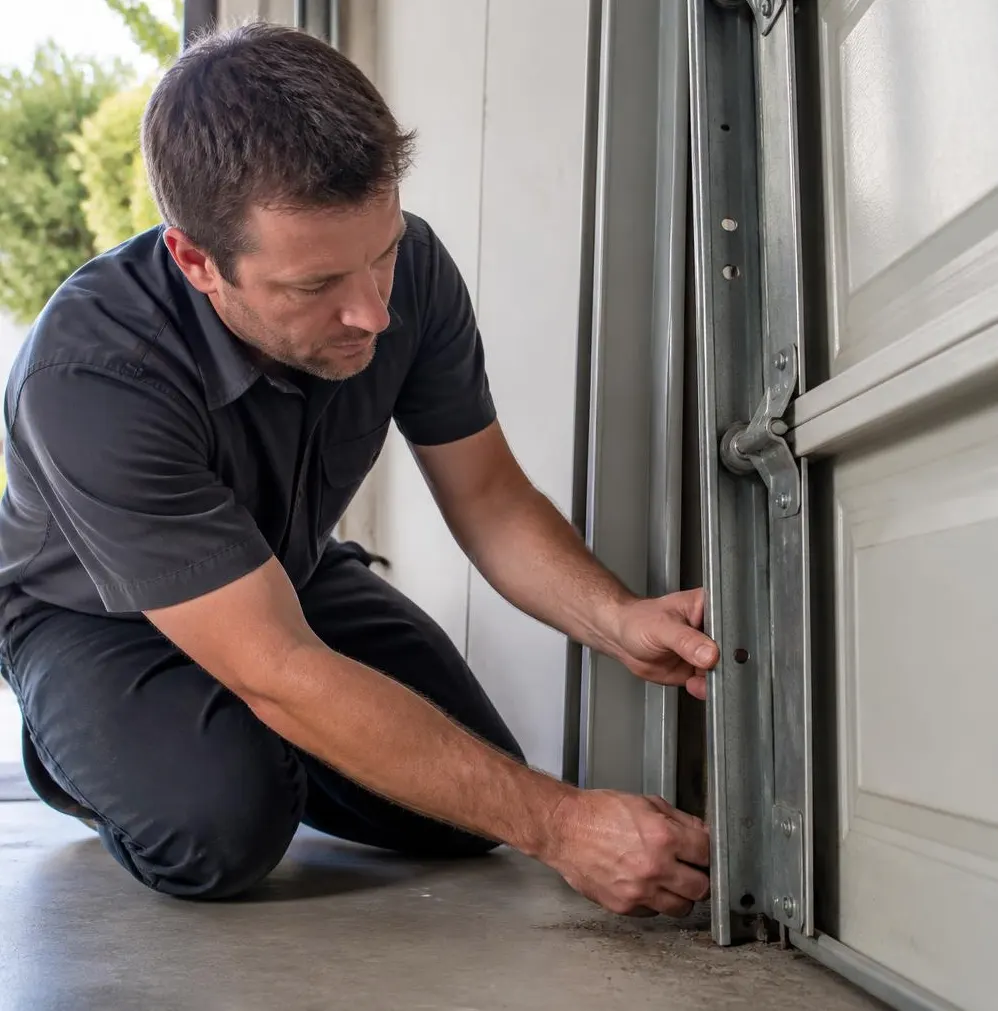
What a Technician Sees After a Wind Event
The calls usually come in the day after a storm front moves through: a door that's bowed outward between the panels, track brackets pulled loose from the framing, or a door that won't budge because it racked sideways in the opening. Sometimes the damage is obvious — a panel caved in from flying debris. Just as often, it's subtle: the door still looks straight, but the rollers are binding, the tracks are slightly bent, and the opener is straining to force a door that's no longer square. Homeowners rarely notice until the next windy day, when the same door starts flexing again.
Why the Garage Door Is a Home's Weakest Wall
A garage door is the largest moving opening in most houses, and unlike a wall, it isn't a solid, continuous structure. It's a series of hinged panels held in place by tracks, rollers, and a spring system — all of it designed to move, not to resist pressure. When wind hits a closed garage door, it pushes against that entire surface at once. If the door isn't braced for it, the panels can bow, the tracks can pull away from the wall, and in the worst cases the whole door can be forced out of its opening. Once that happens, wind gets inside the garage and pushes up on the roof from underneath — which is why building engineers consider a failed garage door one of the more common starting points for wind damage to a house.
Why This Matters More in Fall
Late summer into fall in this part of Texas tends to bring the sudden, severe thunderstorms — the kind with a sharp wind gust line ahead of the rain, sometimes hail mixed in. These storms often arrive with little warning, which means there's no time to improvise bracing after the fact. A door that's already in good mechanical condition handles a surprise gust line far better than one that's been quietly developing problems all summer.
What to Check Before the Next System Rolls Through
- Track alignment: Stand at the side of the door and sight down the track. Any visible bend, gap from the wall, or loose lag bolts means the track can't hold its position under wind load.
- Panel condition: Look for dents, hairline cracks, or warping, especially on older steel or wood doors that have taken years of sun and heat. Weakened panels flex more and fail sooner under pressure.
- Hardware: Hinges, rollers, and end bearing plates should be tight and move smoothly. Loose hinges let panels separate slightly under wind, which is often where bowing starts.
- Weatherstripping and bottom seal: Cracked or missing seals let wind-driven rain inside and are a sign the rest of the door's seals and hardware may be aging out too.
- Opener force settings: If the opener is straining or reversing unexpectedly, it may be compensating for a door that's already slightly out of square.
Reinforcement Options and Trade-Offs
For doors that are structurally sound but under-braced, horizontal or vertical retrofit struts can be added to the back of each panel to stiffen it against wind pressure — a relatively inexpensive upgrade compared to full replacement. Upgraded track brackets anchor the door more securely into the framing, which matters most on older installations where the original hardware was sized for a lighter, non-reinforced door. For homes where the garage door is original to the house or showing its age, replacing it with a wind-rated door is the more permanent fix; it costs more upfront (typically a few thousand dollars depending on size and material, as a general national range) but removes the guesswork going into every storm season. The trade-off is straightforward: retrofitting buys time and costs less now, while replacement solves the problem for good but is a bigger investment.
Don't Forget the Opener
A battery backup for the garage door opener is worth having in this region, where severe storms can knock out power right as wind picks up. Without backup power, a door that's already under pressure can't be closed quickly if it's open when a gust line arrives.
When to Call Rockwall Garage Door Co
If you've noticed track gaps, panel flexing, or a door that's harder to open than it used to be, it's worth having it looked at before the next storm rather than after. Our technicians can inspect the tracks, hardware, and panel condition during a Garage Door Maintenance visit, and if reinforcement or new hardware is needed, we'll walk you through the options rather than pushing straight to a full Garage Door Installation. If a storm has already done damage, our Emergency Garage Door Service can get your garage secured quickly so the rest of your home stays protected.
If you're in Rockwall, Rowlett, Heath, Royse City, Fate, Forney, Garland, or Mesquite and want your garage door checked before the next round of severe weather, call Rockwall Garage Door Co today.